
Author: smbish
New Chapbook Released
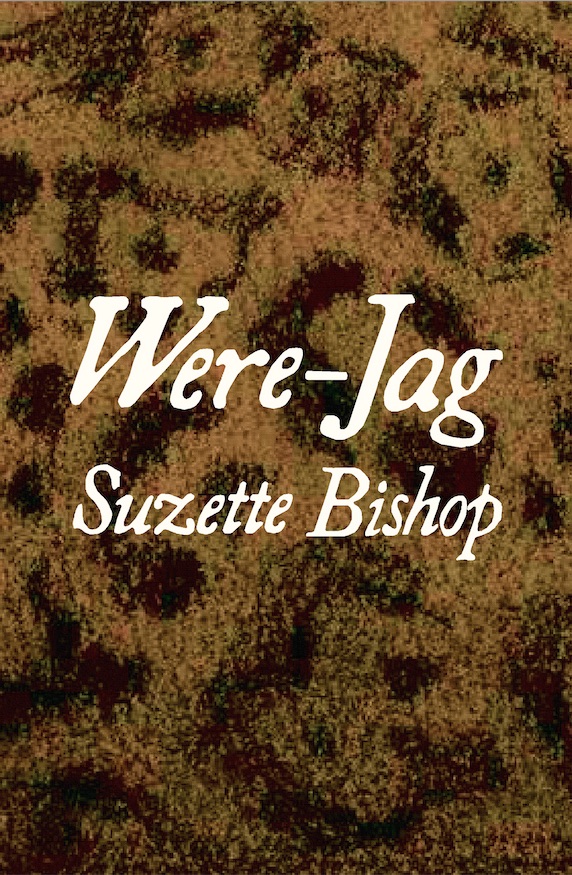
My next chapbook, Were-Jag, was released by Bottlecap Press.
Were-Jag by Suzette Bishop intones, “Were-Jaguar/Where-Jaguar/Wear-Jaguar.” This is where we are: what was, what’s gone, the mask fashion creates. What does it mean to make commodities of ourselves? Three voices entwine in this long collage poem, a journaling voice, a vintage women’s magazine voice, and an encyclopedic voice describing the jaguar and its sacred place, “An eater of hearts” who doesn’t care about being pleasing; “They can roar but not purr.” The speaker of the journal sections mulls over the meaning of her memories, dreams, messy relationships, and female family members who can’t maintain the façades expected of them.
Bishop’s jagged edges where these voices unravel into each other sometimes provide answers, warnings, predictions, “Your own civilization will end.” Or a better understanding of our jaguar selves, living by scents, instincts, “A girl runs to catch the ball, her lithe body swinging through the air,” perhaps a memory of jaguar-like litheness. By contrast, the magazine erasures insist we look cool, unruffled at all times, a still ornament in artificial light, while the speaker of journal entries remarks about a party where “all the women are in costumes; I feel out of place.” In the midst of hacks about how to accessorize a black dress, how to hide falling apart, the magazine voice startles with a revelation about how to be an artist, the importance of having the right tools, being an observer.
New Chapbook Published and Available
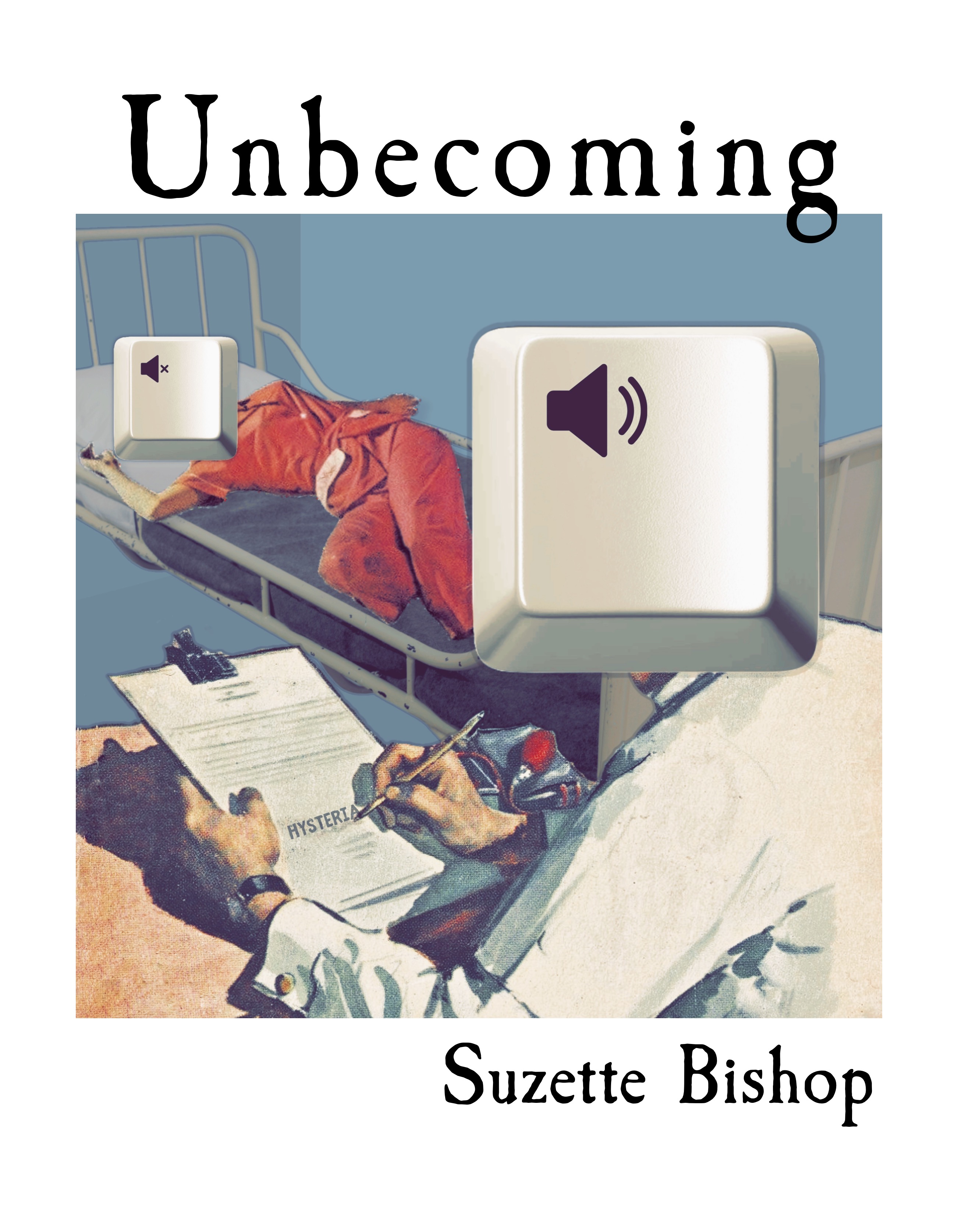
My poetry chapbook, Unbecoming, is now available through Ethel Zine & Micro-press
Advance Reviews:
“Suzette Bishop creates an astonishing tapestry in her long poem, Unbecoming, tracing the illness, ME/CFS, with threads that form a fabric of testimonials, symptoms, advice, scraps from the Sleeping Beauty tale, and magical thinking. Bishop’s mélange of texts harrowingly enacts her journey consisting of disbelief and dismissal from others as well as the betrayal of her own body. ‘Sleeping Beauty finds webs around her like a cocoon,’ she notes, and with multiple voices she pulls us into her struggle along with the stubborn resistance from her soul and mind, enlightening us with her wisdom and expressiveness.”
Molly Bendall, author of Turncoat and Watchful
“This chapbook was an arrow directly aimed at my heart, and it pierced it through. I cried and in the end we triumphed. The lines in this poem cut deep, but the scars left behind heal, and I only wish I could write so eloquently. Suzette Bishop is a fairy full of magic.”
Cynthia Dougherty-Bernal, author of Looking into Infinity and Bleeding on the Page
“Suzette Bishop’s lyrical and authoritative chapbook, Unbecoming, is a compelling and devastating account of the very real suffering of those with ME/CFS. In just a few short pages, Bishop thoroughly and convincingly illustrates the indignities and downright dangers a sufferer must navigate when she is invalidated, gaslit and disappeared by the world around her: The institutions, experts, family, employers, and cultural narratives we’ve been ‘taught’ to trust and need for our physical and mental survival. The stigmatized ME/CFS sufferer is robbed of ‘That glorious word ‘valid’,’
Bishop’s technique of twining the various narrative threads of research, individual experience, and the fairy tale Sleeping Beauty demonstrates the speaker’s attempt to remain intact and coherent while pushing back against disintegration and ‘existential despair.’
At times the narrative form breaks down and words sprinkle down the whiteness of the page. Like an SOS, the sparsity of words forms a Morse Code of dots and dashes, which seeks someone who understands the distress signals.
Breaking the sections into ‘Phases’ and sharing poignant reminders of activities and identities no longer available to the ME/CFS sufferer (‘my horseback-riding gear hung by the door, unused, but still smells of horse’) serve to point out that this is a degenerative and progressive disease.
The impact on the reader is visceral and immediate.
With each ‘Phase’ of severity, the reader senses that the speaker has moved past screaming to be heard and is now exhausted, speaking in a whisper. In that whisper comes a new clarity, like a diamond crystallized under extreme conditions. Her words are culled down. Hard won.
The absolute destruction that ME/CFS wreaks in a person’s life is demonstrated here with clarity of purpose and strength of heart. By book’s end, the speaker asserts, ‘I’m not minimizing’ and ‘Sleeping beauty wakes.’ When all is said and done, there is, unexpectedly, hope.
That this piece exists at all is a sign of hope. We should all recognize the need for such hope, as we face the possibility of our own vulnerability striking unexpectedly: ‘How thin the border is between health and illness . . . between able-bodied and disabled . . . between career and unemployment . . . between control and disjuncture.’ With Unbecoming, Bishop calls us to recognize our own humanity and the vital need for compassion both for ourselves and others. A message, while going ‘back to the beginning of the human species,’ couldn’t be more timely and necessary.”
Nancy Dunlop, author of Hospital Poems
Unbecoming is available at Ethel Zine & Micro-press
New Chapbook Available
My new chapbook, Eyes of Some Robbers, is now available through Dancing Girl Press & Studio.
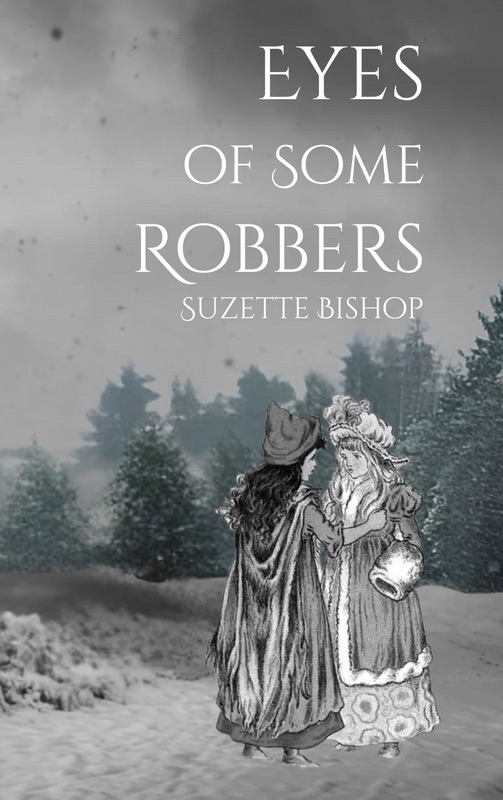
https://dulcetshop.myshopify.com/products/bishop
About Eyes of Some Robbers:
“Bishop’s phantasmagoric writing doesn’t adhere to common form or convention. She walks through her spirit world, using a knife to ‘cut the wires’ that blaze in ‘stolen desert’ as an unapologetic, multifaceted orator of truths. Bishop’s Eyes of Some Robbers stares down the ultimate monster, those collective, oft-ignored harms.”
Candice Louisa Daquin, Managing Editor, Lit Fox Books, author of The Cruelty
“With poems ranging from her childhood to her most recent years, this collection delves into the multifaceted nature of grief, despair, and inner strength. In Eyes of Some Robbers, Bishop endures the many faces of harm–personal, professional, societal–but leaves her readers with hope. Bishop has managed to synthesize it into a collection of profoundly personal poems.”
Mario E. Martinez, Editorial Manager, Bilingual Review/Revista Bilingüe, author of NEO-Laredo and The Chickens That Are Not Her Chickens
“Each poem is crystalline. Chiseled and distillate. As with much of Bishop’s work, there is a deeply ethereal, evocative quality, aptly enough based on a fairy tale. And just like with a fairy tale, the reader is entranced, all the while knowing that danger lurks. Frankly, each poem is a deceptive little explosion. So lovely readers won’t know what hit them. As I read, there were moments when I was literally knocked back in my seat. It was that physical an experience.”
Nancy Dunlop, author of Hospital Poems
Candice louisa Daquin in Conversation with Suzette Bishop for Parcham literary magazine
Jaguar Plays With Magical Realism
An exciting review of Jaguar’s Book of the Dead!

Jaguar does not care for your reality’s boundaries. Jaguar eats them.
Poet and teacher at Texas A & M International University, Suzette Marie Bishop transforms the world around her with her poetry. The rippled cover of Jaguar’s Book of the Dead is delightful to the touch and reinforces Bishop’s mission to captivate her readers by providing them with a tactile as well as mentally stimulating experience. Readers will “…sink lower on your couch…” and watch “…windows steaming up with…jungle humidity…” as they become engrossed with Bishop’s work.

The entire collection is dedicated to jaguars as the animals they are and to the powerful role they have played in human mysticism throughout the years. “Jaguar Remembers You Leaning over Him, Weeping” is a piece that is as supple and elegant as the dying animal is honors. “I know the way to the Underworld…,” the deceased Jaguar says soothingly. Readers will feel…
View original post 197 more words
An Art Walk Through Our Home: Birthday Bowl


Normally, I would be less than thrilled by another woman sticking close to my husband during a dinner party. Not so when ceramist Karen Kahe Charley sat next to my husband and didn’t leave his side all evening. I kept myself occupied enjoying the flickering candles and white flowing curtains in the restaurant as dusk fell.
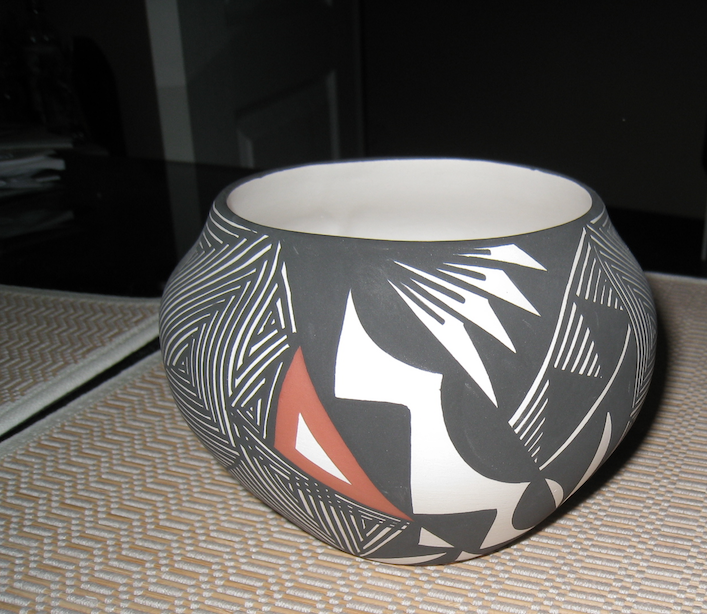
Rather than flirtation, I saw it as a quiet affirmation of the research my husband had just delivered that afternoon at a conference. It hadn’t gone over well with a lot of people. A male elder felt compelled to speak right after my husband finished his presentation. He made it clear my husband was an outsider, and claiming the predominately female makers of Hopi pots might bring something of themselves to their painted designs was abhorrent to him. The designs were traditional, many deemed sacred, although women weren’t privy to their sacred meanings. Rather than depicting the artists as taking down spiritual dictation and accidentally creating a sacred vessel on occasion, my husband noted what distinguished one artist from another within the visual template she was given.

No one would openly disagree with the elder. And my husband didn’t, either, but I could tell it was his worst nightmare. The respectful look on Ms. Charley’s face when speaking with my husband that night said something different, that he had described exactly how you might innovate while also conveying a traditional idea. You might develop a style and command of technique that are uniquely yours and recognizable.
Many months later, I contacted Karen Charley and ordered one of her bowls for my husband’s birthday. I know her choosing to sit beside my husband that evening was a great comfort to him.

Bio—Karen Kahe Charley names her mother, Marcella Kahe, as her mentor. She’s been a potter since 1980 after having three children. She has been awarded Best of Show, Best of Division, and Best Traditional Pottery at the Museum of Northern Arizona and at the Santa Fe Indian Market. Karen Kahe Charley was born into the Butterfly-Badger Clan in the village of Sichomovi at First Mesa.

An Art Walk Through Our Home: Wedding Gift


Since I wrote about a Debra Hensley-Luczycki print in my last blog, An Art Walk Through Our Home: The Smirking Heart https://suzettemariebishop.com/2019/02/18/an-art-walk-through-our-home-the-smirking-heart/, I thought I’d write a poem response to a second print by her. Debra surprised us with this print which she gave to us as a wedding present. The print is appropriately titled Something Old, Something New, Something Borrowed, Something Turquoise.
Our Turquoise Pools of Quiet

The shower curtain clips,
I start unhooking them at one end,
You at the other end,
Some pull open easily,
Others stay stubbornly closed.
I leave those for you to try.
Yesterday, you washed the dishes
So I’d have a spoon for my cereal.
We need more spoons,
We can use all the ones we have
In a day, sitting in the grey sink,
Some days we need halos,

Plates falling, veils lifting off,
Tools, missing parts in the junk drawer.
I finally got us a tool bag,
Organized the nails, duct tape, dust mask,
Large enough for the hammer on the bottom,
Messages on torn paper.
The filmy shower liner tossed,
We begin attaching the new one,
Unfolding the plastic pleats,
Thread the round hooks through,

Magnets seal them at the sides of the tub,
Porcelain echoes metal.
I often don’t know what to say,
You and the cat never mind
An Art Walk Through Our Home: The Smirking Heart
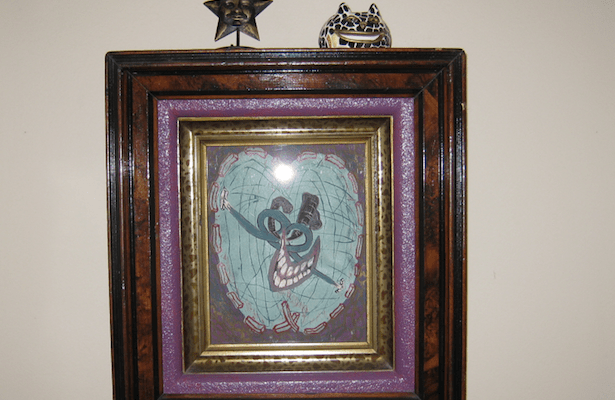
What’s at the center of the heart?
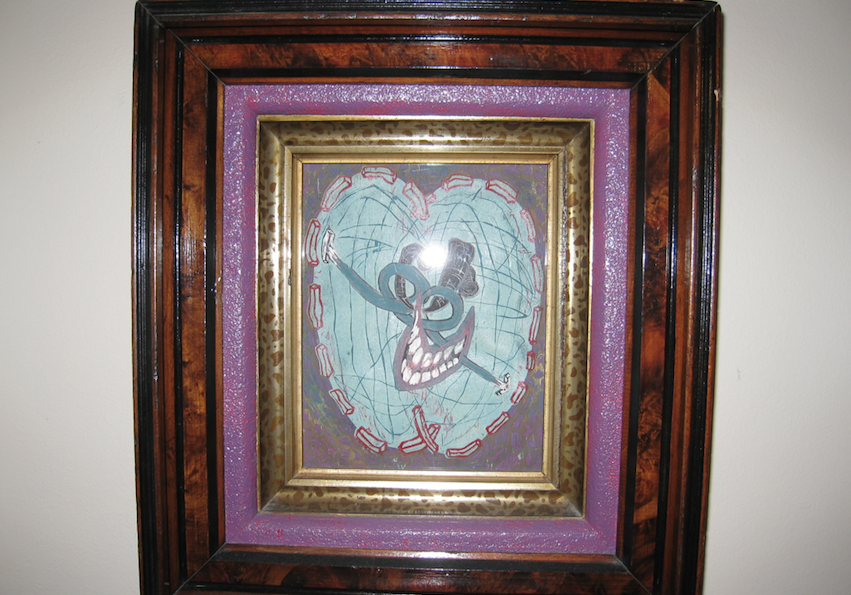
In this print hanging near our dining table, Debra Hensley-Luczycki answers that question with a smirk, the exhaust of Cupid’s arrow’s flight, and unconnected black tubing. Keep in mind, this print from the early 1990’s completed when Hensley-Luczycki was a graduate student at Tulsa University, is featuring a smirk way before it was a trendy term.
The arrow must have done some airplane-like flips to show off before exiting out the mouth like a rose held between the teeth.

The arrow’s tip is headed for one of the barriers outlining the heart. Will it collide? Escape through a gap? Or blast through the barrier, pushing it out into the space surrounding the heart? It’s left up to us to imagine how the heartthrob all plays out. Three-dimensional rectangular shapes echoing the arrow’s tail make up the barriers, but they seem more decorative than protective. More like shapes placed on the heart to accentuate the heart shape and its red color we’ve learned to expect. More like disconnected tubing or macaroni pieces.
 Really, the heart is a blue vein color when you open it up and look inside. Or gangrene from love sickness and the arrow’s strike, which is the same color. Animated lines head excitedly somewhere, or the blood within these delicate blue-green veins goes nowhere, doubling back. The heart seems swollen to bursting.
That arrow/airplane’s flight exhaust of loop de loops creates eyes above the mouth, the tubing, our brain disconnected or primed for a connection. Having eaten way too many cupcakes this Valentine’s Day, I’m in no shape to say.
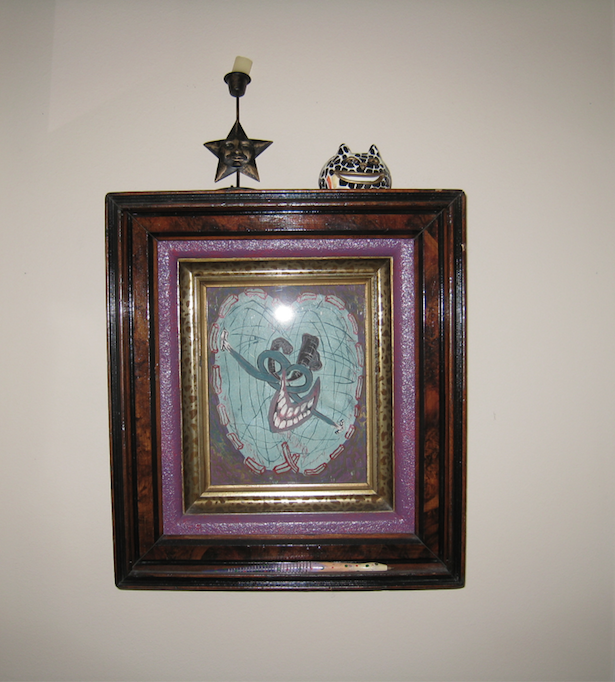
 Frames guard the heart. The innermost frame is gold painted. The next frame is painted with an animal print pattern, perhaps some of our wildness. A sexy purple and red textured frame extends out next, and the outermost frame is like varnished mahogany. Do we protect or hide the heart with these parts of ourselves? Invite others in? They aren’t such solid and separate compartments, the frames’ colors and shapes mixed together on the print just outside the heart’s delineations, some of the shapes themselves heart-like. If we chipped away here, gold or aqua would be found underneath. Fool’s gold or a heart of gold?
As a witness to my wedding, I didn’t expect Debra to act as bridesmaid. Still, she brought me wild flowers she found for a bouquet. The classic Cadillac she borrowed from her parents delivered us to the courthouse in style and pulled into Sonic afterwards. She brought wildness, classic style, and joking to the day. And I see all of those in this art work she gave us.
And a sturdy altar to those parts of us, to what’s illusion, what’s cartoon, what isn’t contained, what’s gaudy. To a mix of sculpture, print, and painting. To that, I’ve added a few things: star candlestick, snake pen, grinning cat.
 suzettemariebishop