Uncategorized
New Chapbook Released
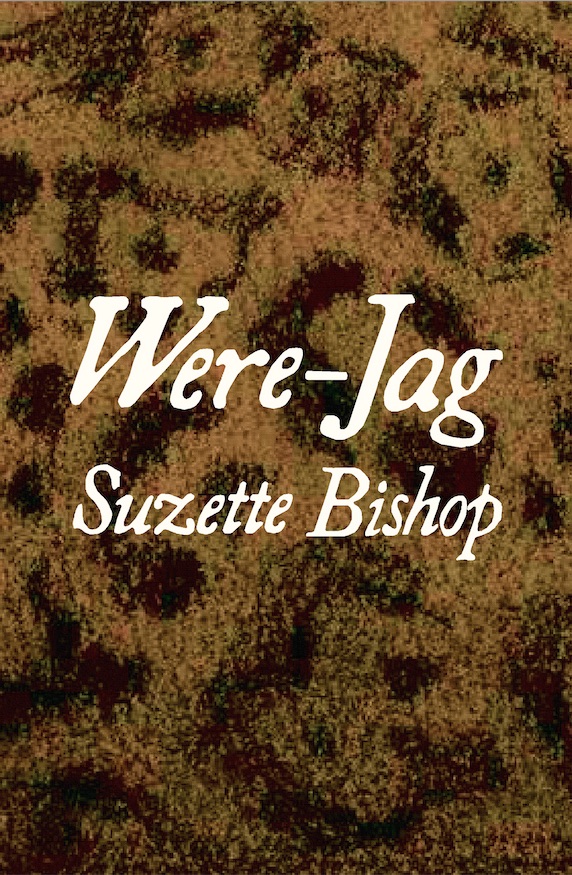
My next chapbook, Were-Jag, was released by Bottlecap Press.
Were-Jag by Suzette Bishop intones, “Were-Jaguar/Where-Jaguar/Wear-Jaguar.” This is where we are: what was, what’s gone, the mask fashion creates. What does it mean to make commodities of ourselves? Three voices entwine in this long collage poem, a journaling voice, a vintage women’s magazine voice, and an encyclopedic voice describing the jaguar and its sacred place, “An eater of hearts” who doesn’t care about being pleasing; “They can roar but not purr.” The speaker of the journal sections mulls over the meaning of her memories, dreams, messy relationships, and female family members who can’t maintain the façades expected of them.
Bishop’s jagged edges where these voices unravel into each other sometimes provide answers, warnings, predictions, “Your own civilization will end.” Or a better understanding of our jaguar selves, living by scents, instincts, “A girl runs to catch the ball, her lithe body swinging through the air,” perhaps a memory of jaguar-like litheness. By contrast, the magazine erasures insist we look cool, unruffled at all times, a still ornament in artificial light, while the speaker of journal entries remarks about a party where “all the women are in costumes; I feel out of place.” In the midst of hacks about how to accessorize a black dress, how to hide falling apart, the magazine voice startles with a revelation about how to be an artist, the importance of having the right tools, being an observer.
New Chapbook Published and Available
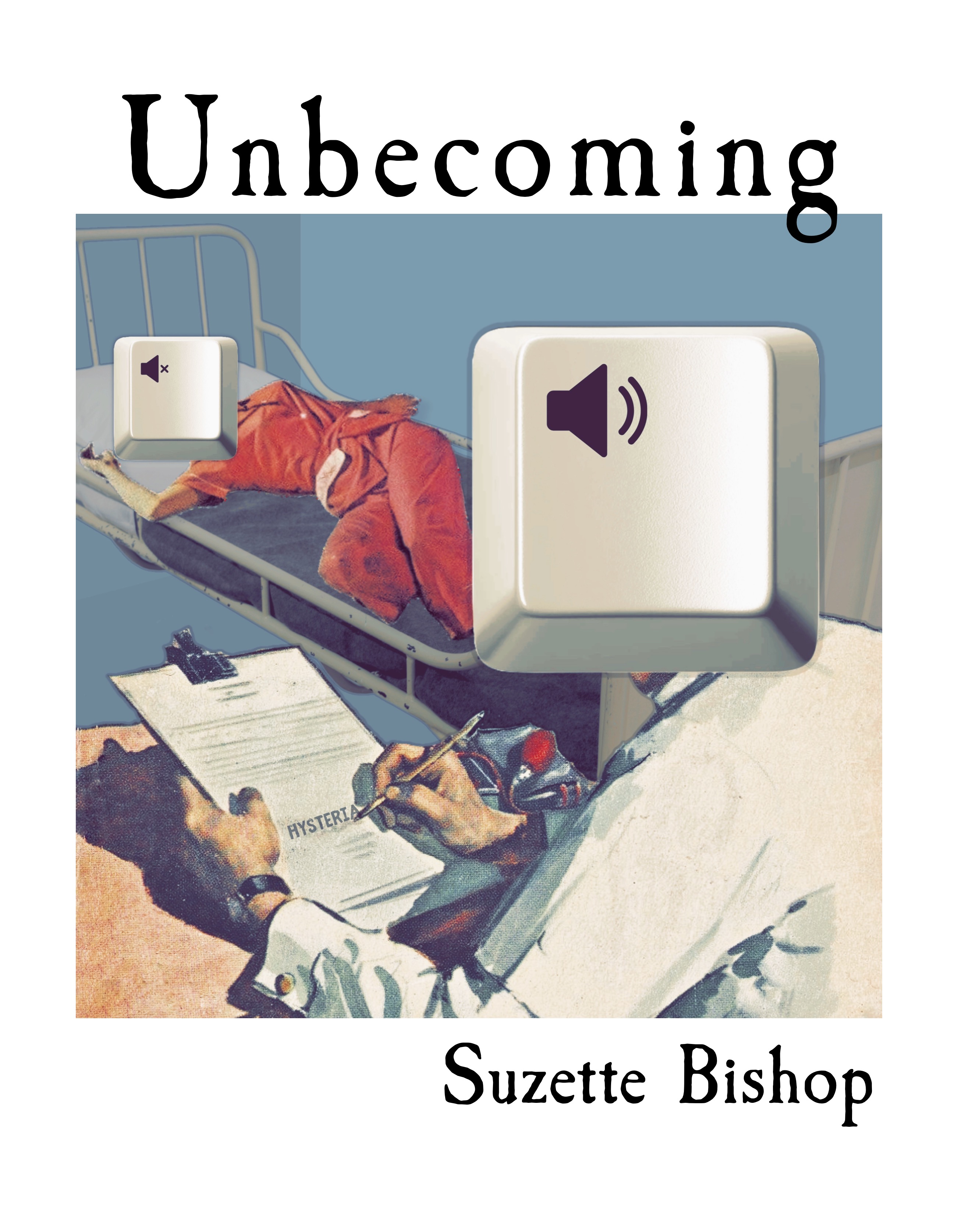
My poetry chapbook, Unbecoming, is now available through Ethel Zine & Micro-press
Advance Reviews:
“Suzette Bishop creates an astonishing tapestry in her long poem, Unbecoming, tracing the illness, ME/CFS, with threads that form a fabric of testimonials, symptoms, advice, scraps from the Sleeping Beauty tale, and magical thinking. Bishop’s mélange of texts harrowingly enacts her journey consisting of disbelief and dismissal from others as well as the betrayal of her own body. ‘Sleeping Beauty finds webs around her like a cocoon,’ she notes, and with multiple voices she pulls us into her struggle along with the stubborn resistance from her soul and mind, enlightening us with her wisdom and expressiveness.”
Molly Bendall, author of Turncoat and Watchful
“This chapbook was an arrow directly aimed at my heart, and it pierced it through. I cried and in the end we triumphed. The lines in this poem cut deep, but the scars left behind heal, and I only wish I could write so eloquently. Suzette Bishop is a fairy full of magic.”
Cynthia Dougherty-Bernal, author of Looking into Infinity and Bleeding on the Page
“Suzette Bishop’s lyrical and authoritative chapbook, Unbecoming, is a compelling and devastating account of the very real suffering of those with ME/CFS. In just a few short pages, Bishop thoroughly and convincingly illustrates the indignities and downright dangers a sufferer must navigate when she is invalidated, gaslit and disappeared by the world around her: The institutions, experts, family, employers, and cultural narratives we’ve been ‘taught’ to trust and need for our physical and mental survival. The stigmatized ME/CFS sufferer is robbed of ‘That glorious word ‘valid’,’
Bishop’s technique of twining the various narrative threads of research, individual experience, and the fairy tale Sleeping Beauty demonstrates the speaker’s attempt to remain intact and coherent while pushing back against disintegration and ‘existential despair.’
At times the narrative form breaks down and words sprinkle down the whiteness of the page. Like an SOS, the sparsity of words forms a Morse Code of dots and dashes, which seeks someone who understands the distress signals.
Breaking the sections into ‘Phases’ and sharing poignant reminders of activities and identities no longer available to the ME/CFS sufferer (‘my horseback-riding gear hung by the door, unused, but still smells of horse’) serve to point out that this is a degenerative and progressive disease.
The impact on the reader is visceral and immediate.
With each ‘Phase’ of severity, the reader senses that the speaker has moved past screaming to be heard and is now exhausted, speaking in a whisper. In that whisper comes a new clarity, like a diamond crystallized under extreme conditions. Her words are culled down. Hard won.
The absolute destruction that ME/CFS wreaks in a person’s life is demonstrated here with clarity of purpose and strength of heart. By book’s end, the speaker asserts, ‘I’m not minimizing’ and ‘Sleeping beauty wakes.’ When all is said and done, there is, unexpectedly, hope.
That this piece exists at all is a sign of hope. We should all recognize the need for such hope, as we face the possibility of our own vulnerability striking unexpectedly: ‘How thin the border is between health and illness . . . between able-bodied and disabled . . . between career and unemployment . . . between control and disjuncture.’ With Unbecoming, Bishop calls us to recognize our own humanity and the vital need for compassion both for ourselves and others. A message, while going ‘back to the beginning of the human species,’ couldn’t be more timely and necessary.”
Nancy Dunlop, author of Hospital Poems
Unbecoming is available at Ethel Zine & Micro-press
New Chapbook Available
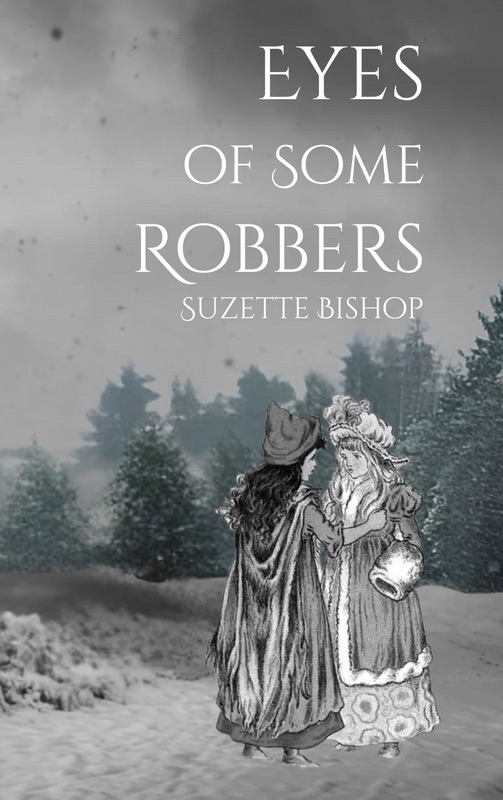
My new chapbook, Eyes of Some Robbers, is now available through Dancing Girl Press & Studio.
https://dulcetshop.myshopify.com/products/bishop
About Eyes of Some Robbers:
“Bishop’s phantasmagoric writing doesn’t adhere to common form or convention. She walks through her spirit world, using a knife to ‘cut the wires’ that blaze in ‘stolen desert’ as an unapologetic, multifaceted orator of truths. Bishop’s Eyes of Some Robbers stares down the ultimate monster, those collective, oft-ignored harms.”
Candice Louisa Daquin, Managing Editor, Lit Fox Books, author of The Cruelty
“With poems ranging from her childhood to her most recent years, this collection delves into the multifaceted nature of grief, despair, and inner strength. In Eyes of Some Robbers, Bishop endures the many faces of harm–personal, professional, societal–but leaves her readers with hope. Bishop has managed to synthesize it into a collection of profoundly personal poems.”
Mario E. Martinez, Editorial Manager, Bilingual Review/Revista Bilingüe, author of NEO-Laredo and The Chickens That Are Not Her Chickens
“Each poem is crystalline. Chiseled and distillate. As with much of Bishop’s work, there is a deeply ethereal, evocative quality, aptly enough based on a fairy tale. And just like with a fairy tale, the reader is entranced, all the while knowing that danger lurks. Frankly, each poem is a deceptive little explosion. So lovely readers won’t know what hit them. As I read, there were moments when I was literally knocked back in my seat. It was that physical an experience.”
Nancy Dunlop, author of Hospital Poems
Candice louisa Daquin in Conversation with Suzette Bishop for Parcham literary magazine
Jaguar Plays With Magical Realism
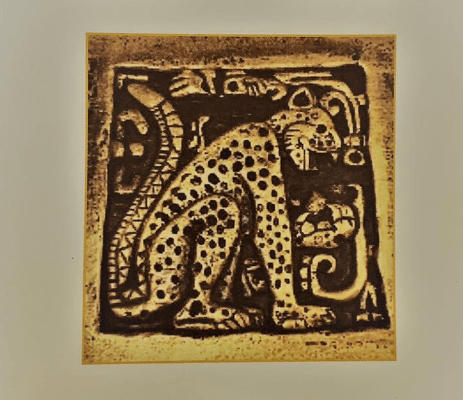
An exciting review of Jaguar’s Book of the Dead!

Jaguar does not care for your reality’s boundaries. Jaguar eats them.
Poet and teacher at Texas A & M International University, Suzette Marie Bishop transforms the world around her with her poetry. The rippled cover of Jaguar’s Book of the Dead is delightful to the touch and reinforces Bishop’s mission to captivate her readers by providing them with a tactile as well as mentally stimulating experience. Readers will “…sink lower on your couch…” and watch “…windows steaming up with…jungle humidity…” as they become engrossed with Bishop’s work.

The entire collection is dedicated to jaguars as the animals they are and to the powerful role they have played in human mysticism throughout the years. “Jaguar Remembers You Leaning over Him, Weeping” is a piece that is as supple and elegant as the dying animal is honors. “I know the way to the Underworld…,” the deceased Jaguar says soothingly. Readers will feel…
View original post 197 more words
New Chapbook Now Available

My new poetry chapbook published by Presa Press, Jaguar’s Book of The Dead, is now available: http://presapress.com/books/jaguars-book-of-the-dead
An Art Walk Through Our Home: My Home Is My Castle

Maul, mace? Yes, “maul” can be a noun. This sculpture by Tom Luczycki is part medieval tool, part Flintstones’ household object (though post-Flintstones would be more accurate since it’s made of metal). It’s probably fashioned from scrap metal, the prongs welded to the bottom. It’s like something you’d see in a cartoon or a movie featuring Visigoths, a Hollywood version of Visigoths, that is.
But it’s waaaaaay too heavy to be a prop. At the same time, I don’t think it’s meant to split wood, as the definition of a maul claims, but to split open someone’s head. Or, pretend to. Or, to suggest, I could split your head open if I wanted to. My husband reminds me, Luczycki gave the sculpture to my husband because of my husband’s late hours at the office, adding he thought, “the prongs would do a real number on someone’s side, embedded between the ribs.” He gave a demonstration, holding the handle and swinging it slowly toward my husband’s ribs.
It’s always helpful to have instructions like this come with your sculpture, don’t you think?
It’s a boyhood toy, hollow, but with adult features that really could do some serious damage, unlike a plastic toy. Circular bumps help with the grip at the top but would not be pleasant if you were to rub those up and down someone’s flesh, for instance. “Thud” is what I imagine it would sound like to actually crash its sledge tips into something, castle wall, say. It says, “I will protect you.” Also, “You might want to get a tetanus shot.” It also says, “maul” is a noun and a verb, and it’s ready to serve up both forms of the word.

I feel like I need a moat to go with it.
I like a placement where the maul is steadying itself against a bookcase. An eye-catching “display” doesn’t seem right for this sculpture and its suburban setting. Its lovely brownish patina blends in with the bookcase’s wood, its “feet” resting on the soft carpet. When not in use, I think it needs to be something stumbled upon, casually threatening. And above the bookcase is a painting by Luczycki’s wife—I’m glad we found a spot to have both artists’ works near each other.

Luczycki was a graduate student in art at Tulsa University where my husband was teaching art history. He was getting his second masters. Luczycki and his wife, another graduate student in art, were witnesses at our wedding and took photos. And didn’t have any problem going to Sonic after the ceremony. Besides being the Head of Exhibits at the Sam Noble Oklahoma Museum of Natural History, Luczycki’s blogs discuss his love of spear and boomerang throwing. Makes sense.
An Art Walk Through Our Home: Frida Doll
I made the announcement at eleven. I told my mother, “I’m not playing with dolls any more.”
I didn’t expect her measured response, “Yes, that’s probably a good idea.”
I don’t know why that startled me. Did I expect my mom to actually be sentimental about my dolls, their motor homes, shoes, dresses, furniture, and dramas scattered all over the living room floor?
But I think I did hear a little twinge when she added, “You are getting bigger.” I’d outgrown dolls, and it signaled a change for both of us.
* * *
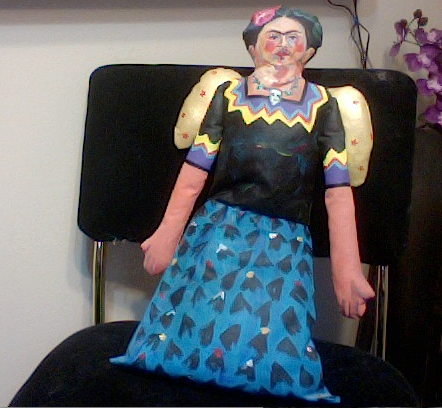
Frida came as a big surprise. My husband gave her to me for my birthday one year. She is made by the painter Marsha Moore Hughes, another colleague of my husband who taught painting at Tulsa University. When my husband and I went to the opening of a faculty exhibit, my husband pointed to the Frida piece, telling me she was mine! I couldn’t wait for the exhibit to come down so I could take her home. She is not to be played with but stands on the top shelf of a bookcase in our living room where she surveys all from her perch.

She reminds me a bit of Hughes in her facial features. As a female painter, the connection Hughes might feel with the Mexican painter is obvious. And maybe subconscious since the details of Frida’s face are there, her unibrow and moustache. The blushing cheeks and round face remind me of Hughes, though. And those are the eyes I remember welcoming us to art department parties Hughes would host at her home.
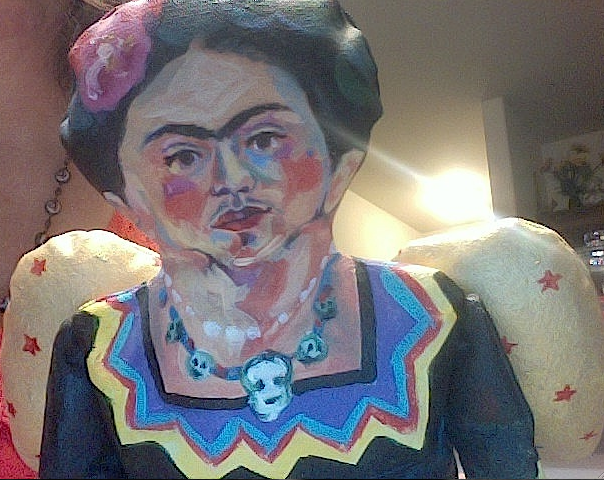
I didn’t need to make up a life and loves for her. I’d read her biography, seen a documentary about her. Appropriately, female decorative arts merge in her making as she is sewn together, hand-painted, and stuffed. She wears her traditional dress that looks like it was fun to paint using bright colors, patterns, and splashes of paint. The skulls on her Día de los Muertos necklace look positively chipper.
* * *
I have Fibromyalgia, and today was painful. I wanted to cry at the grocery store. Frida may have had Fibromyalgia, too. Certainly, she had pain from her accident and the procedures to repair the damage. Pain that amplified upon itself. The other day, I read that more nerve endings have been found in the hands of women with Fibromyalgia. Like weeds growing. The amplification isn’t in our heads.
But this Frida can fly when she needs to. No pain.
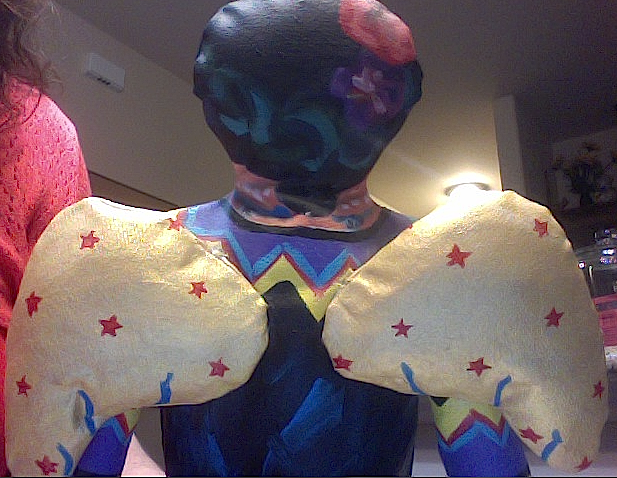
When my husband gave her to me, I didn’t have Fibromyalgia, I didn’t live in a border town where Frida would cross by train, I didn’t know I may have some Taíno ancestry, which has links to ancient South American indigenous people. I didn’t live in a culture where it’s considered very strange not to have children. I think I am growing into having my Frida doll.
Excuse me–it’s time for a tea party.
 suzettemariebishop